
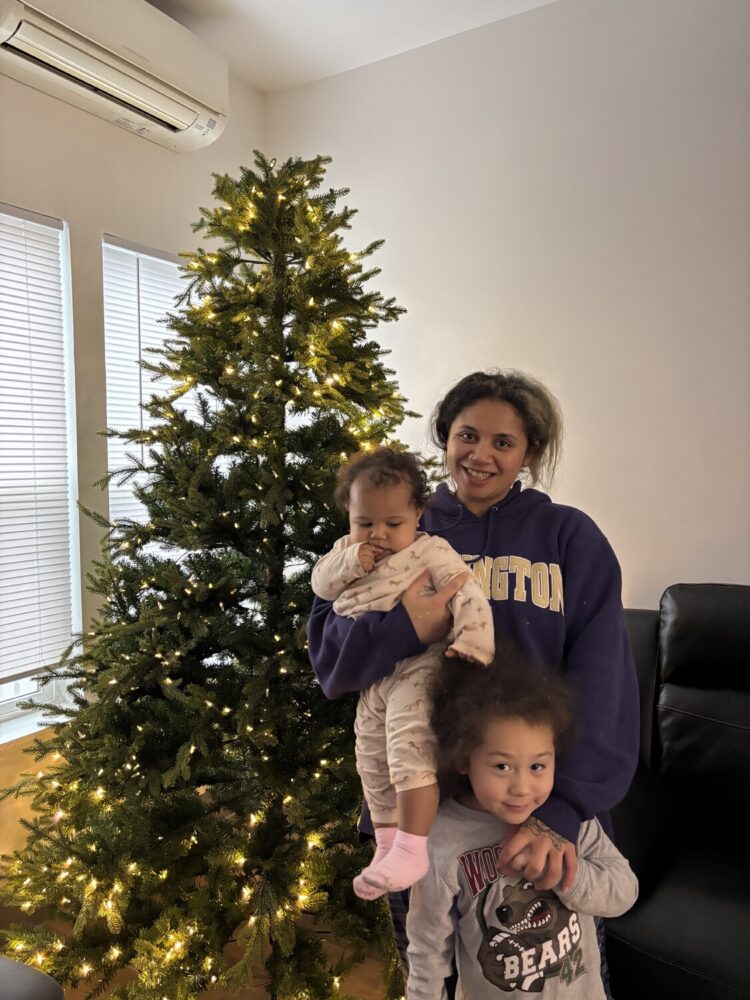
When Faye stepped into her new apartment for the first time, she didn’t explore the rooms or check the view. She stood in the doorway and cried. After months of uncertainty, fear, and exhaustion, the simple act of turning a key and walking into a home of her own felt overwhelming. “I cried. That was the very first thing I did,” she said. “I thanked God.”
For a long stretch, Faye had been living in her car with her two young children, doing everything she could to keep them safe and shield them from the instability around them. Being unhoused, she explained, felt like waking up each day without knowing what would come next. “If I had to describe it in one word, it would be sad,” she said. “You don’t know what the next day is going to look like. You don’t have a roof over your head. You’re just trying to figure it out.”
She tried to make the experience feel like an adventure for her kids, “like we were on vacation or the next adventure.” But inside she carried the weight of fear, responsibility, and the constant pressure to keep going.
Breaking Stereotypes About Homelessness
Faye’s story challenges the assumptions often placed on people experiencing homelessness. She was working the entire time even throughout her pregnancy. “I never stopped working,” she said. “I pulled doubles, 16‑hour shifts, everything. But even working four or five days a week, it still wasn’t enough to save for a house.”
When her partner became incarcerated, she suddenly found herself alone. At five months pregnant, she received a 30‑day notice to vacate. She chose to leave before an eviction hit her record, even though she had nowhere to go. “I was scared reckless,” she said. “I didn’t know where we were going to go next or how I was going to afford anything outside of the car.”
She wants people to understand that homelessness is not a moral failing. “People think you’re not trying, or you’re just sitting on your ass,” she said. “But that’s not true. You can be working hard and still not make ends meet — especially out here in Seattle.”
Loss, Resilience, and the Weight of Doing It Alone
Faye’s journey has also been shaped by deep personal loss. Her father, her primary source of support, was killed when she was seventeen. “My dad died in my arms,” she shared quietly. “After that, everybody disappeared. I didn’t have that support like other people.”
Without family to lean on, she carried the responsibility of raising her children entirely on her own. She paid for daycare out of pocket. She enrolled in a medical assistant program, a dream she’d had since she was a little girl, but the cost of tuition and childcare made it impossible to continue. “I just couldn’t afford it,” she said. “It was too much for me to keep going to school and try to save for a house.”
During one of her lowest moments, she connected with Mary’s Place. Faye had run out of diapers and food, and her children had been sitting in the same diapers for hours. They invited her to come in and handed her a bag filled with diapers, snacks, and essentials. That small act of kindness gave her enough relief to get through the next couple of days. It reminded her that there were people who cared.
Even with moments of support, she often felt surrounded by false hope. She reached out to countless programs, waited on long lists, and tried every path she could find. She was close to giving up when she was connected to the GD Association. For the first time, the process felt clear, honest, and fast. Within weeks, she and her children were handed the keys to a fully furnished apartment in Seattle’s Central District.
A Place That Feels Like Home
The neighborhood immediately felt right. “It feels like a safe zone,” she said. “It feels like home.” For the first time in a long time, she could come home to a real space instead of a car. She could tuck her children into their own beds. She could breathe. “Just coming home to a house and not a car — that’s the best part,” she said. “Bringing my kids home to a roof over their head.” Every day in her new home feels like a celebration. “I find myself crying a couple times a day because I’m just very, very grateful,” she said. “It almost feels unreal.”
With stability finally within reach, Faye has begun thinking about the future again. She still hopes to return to school and pursue her dream of becoming a medical assistant. She also knows what kind of support would help young mothers like her thrive: mentorship, guidance, and accessible childcare. She believes that having someone to call for advice on parenting, finances, school, or even meal planning would make a meaningful difference for families trying to rebuild their lives.
A New Beginning
As Faye begins this new chapter, her story becomes part of a much larger legacy, one the GD Association has been building for more than three decades. Executive Director Terry Lott reflects on that history with pride: “Stories like Faye’s remind us why the GD Association exists. From our early days supporting teen parents through the Aridell Mitchell Home to the work we do now, helping young mothers build a foundation for their future isn’t new for us; it’s part of our legacy. When we open the door to a safe home, we’re not just providing shelter — we’re rebuilding the community, restoring hope, and ensuring that every family has the chance to thrive right here in the city they call home.” Faye’s journey is a testament to that mission; a reminder that when dignity is restored and community steps forward, new beginnings become possible.